
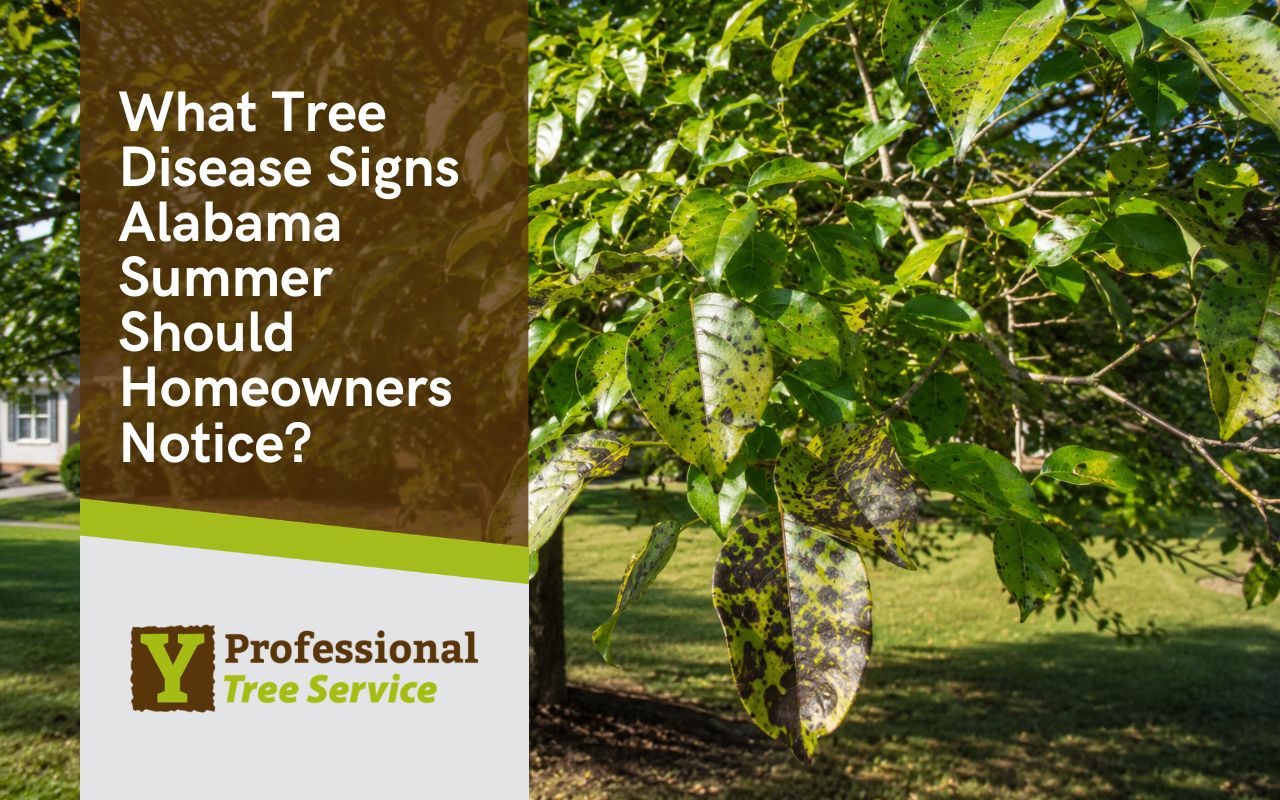
Alabama summer can hide tree problems behind green leaves and thick shade. Therefore, homeowners should check trees often during heat, storms, and humidity. At Y Professional Tree Service, we help property owners notice early warning signs, understand possible causes, and choose safe next steps with our guide to common tree diseases in the Southeast.
What Tree Disease Signs Alabama Summer Should Homeowners Notice?
Tree disease signs Alabama summer homeowners should notice include wilting leaves, dark spots, cankers, bark holes, early leaf drop, and sudden branch dieback. These signs often point to fungal infection, pest stress, oak wilt, or heat-related decline that needs prompt inspection. Learn helpful care steps in how to cure a diseased tree.
Tree disease signs Alabama summer means the visible changes that show a tree may be sick during hot, humid months. At Y Professional Tree Service, we use these signs to help homeowners, property managers, and landowners find disease early, reduce spread, and avoid unsafe tree decline.
Summer Heat Reveals Hidden Tree Health Problems Much Earlier
Summer heat often reveals tree problems because weak roots, dry soil, and disease stress become harder to hide. Therefore, homeowners should look for leaf scorch, early leaf drop, thinning crowns, and dead twigs before damage spreads into major limbs or nearby trees.
Many symptoms look simple at first. However, they can point to deeper stress. Leaf scorch may show brown edges. Anthracnose may cause dark leaf spots. Cankers may create sunken, dead bark patches.
Alabama Cooperative Extension explains that drought and root stress can increase tree susceptibility to insects and diseases. Therefore, leaf scorch, wilting, thinning foliage, and bark cracks should be checked during hot summer weather.
- Check leaves for brown edges, spots, or sudden yellowing.
- Look at bark for cracks, cankers, holes, or oozing sap.
- Watch the crown for thinning, dead limbs, or uneven growth.
- Inspect the trunk base for mushrooms, sawdust, or soft wood.
Early checks help protect shade, safety, and curb appeal. Therefore, take photos when symptoms appear. Then, compare changes every few days during hot weather.
High Humidity Encourages Fungal Trouble Across Alabama Yards
High humidity encourages fungal infections because wet leaves and still air help spores survive longer. Therefore, fungal infections trees high humidity in Alabama can spread quickly in crowded yards, shaded areas, and places where rainwater stays on foliage overnight.
At Y Professional Tree Service, we often explain that humidity does not harm every tree alone. However, moisture, poor airflow, wounds, and weak roots can work together. As a result, leaf spots, mildew, rust, and cankers may appear faster.
Damp foliage gives many fungal problems more time to spread across leaves and twigs. Therefore, homeowners should improve airflow, reduce standing moisture, and avoid watering leaves late in the day.
| Summer Condition | Helpful Homeowner Action |
|---|---|
| Dense canopy with poor airflow | Schedule selective pruning to help leaves dry faster. |
| Mulch piled against the trunk | Pull mulch back to keep bark drier and healthier. |
| Wet leaves late in the day | Water early so foliage dries before night. |
| Fallen infected leaves under trees | Remove debris to reduce spore spread. |
Fungal disease often begins where moisture stays longest. Therefore, improve drainage, reduce crowding, and avoid overhead watering when possible.
Key Takeaway: Summer heat and humidity can expose weak trees quickly. Therefore, early checks and better airflow reduce disease pressure before symptoms become serious.
Early Inspections Catch Fungal Tree Symptoms Before They Spread
Early inspections catch fungal symptoms while treatment is still simpler and less stressful for the tree. Therefore, homeowners should inspect leaves, bark, limbs, and the soil line after storms, rainy weeks, or sudden summer heat.
Tree disease signs Alabama summer often start small. However, small signs can become large problems. Look for powdery white coating, rusty spots, black lesions, wilting during midday, or rings on infected leaves.
These signs matter because fungal spores can move through wind, splashing rain, and infected debris. Therefore, sanitation is a practical first step. Remove affected leaves when safe. Also, clean tools after cuts.
- Clean pruning tools between trees.
- Remove fallen diseased leaves from the yard.
- Water near the soil, not over the leaves.
- Improve sunlight and airflow through careful pruning.
- Ask for diagnosis before using chemical treatments.
Fungal infection can look like drought stress. Therefore, do not guess from leaf color alone. A careful inspection helps separate disease, insects, root damage, and heat stress.
Bark Beetles Damage Stressed Trees During Hot Alabama Months
Bark beetles damage stressed trees by tunneling under bark and disrupting sap flow. Therefore, bark beetles Alabama summer activity should be checked when trees show boring dust, small holes, pitch spots, yellowing crowns, or sudden branch death.
Alabama Cooperative Extension explains that three bark beetle species are commonly found in Alabama: southern pine beetle, black turpentine beetle, and Ips engraver beetles.
Alabama Cooperative Extension also explains that pine bark beetles tunnel beneath bark, feed on the phloem, and can carry fungi that speed tree decline. Therefore, small holes, pitch tubes, boring dust, and crown color changes deserve quick attention.
- Boring dust near bark cracks can signal active tunneling.
- Pitch tubes may show where the tree tried to defend itself.
- Yellow or reddish crown color can show advanced stress.
- Loose bark may reveal galleries under the surface.
Healthy trees often resist insects better. Therefore, water deeply during dry periods, protect roots from soil compaction, and remove severely infested material when needed.
Key Takeaway: Fungal symptoms and bark beetle signs can spread fast in summer. Therefore, clean habits, stress reduction, and early diagnosis protect nearby trees.
June Oak Checks Protect Valuable Alabama Shade Trees Faster
June oak checks protect valuable shade trees because oak wilt can move quickly once symptoms appear. Therefore, oak wilt signs June homeowners should watch for wilting leaves, tan or brown margins, sudden leaf drop, and branch decline.
Oak wilt may look like drought, leaf scorch, or root stress. However, fast decline on one branch or one side of the tree can be serious. Dark streaking under bark may also point toward vascular disease.
Fresh wounds can increase risk during active insect periods. Therefore, avoid unnecessary oak pruning in early summer. If pruning is required for safety, ask about proper timing and wound care.
Oak wilt can affect valuable shade trees and nearby oaks. Therefore, quick action matters. A professional inspection can confirm whether pruning, treatment, monitoring, or removal is the safer option.
Local Diagnosis Guides Safer Treatment Around Huntsville Homes Today
Local diagnosis guides safer treatment because Huntsville trees face heat, storms, insects, compacted soil, and humid air together. Therefore, tree disease treatment in Huntsville, AL should begin with identifying the real cause before spraying, pruning, or removing limbs.
At Y Professional Tree Service, we inspect leaves, bark, canopy shape, trunk base, and surrounding soil. Then, we explain what we find in plain language. This helps homeowners understand the problem before choosing treatment.
Some problems need pruning. Others need watering changes, mulch correction, pest management, or follow-up monitoring. Therefore, the right solution depends on the tree species, disease stage, and safety risk.
Homeowners can learn more about regional disease issues in our guide to common tree diseases in the Southeast. Also, they can request help through our contact our tree care team page.
Key Takeaway: Oak problems and Huntsville tree diseases need accurate diagnosis. Therefore, local experience helps homeowners avoid guesswork and choose safer care.
Smart Choices Reduce Removals And Preserve Mature Trees Safely
Smart choices reduce removals because many tree problems can be managed when found early. Therefore, homeowners should compare tree value, safety risk, disease severity, and treatment options before deciding whether to save or remove a mature tree.
A mature tree can add shade, beauty, and habitat. However, a tree with advanced decay can become unsafe during summer storms. Therefore, preservation must always include safety.
Use this decision-help list during a first visual check:
- Preserve the tree when symptoms are limited and the structure is stable.
- Treat the tree when disease is active but still manageable.
- Monitor the tree when symptoms are mild or unclear.
- Remove the tree when decay, lean, or disease creates serious risk.
Tree disease signs Alabama summer can change quickly after storms. Therefore, check the same tree again after heavy rain, strong wind, or long heat waves.
Proven Care Combines Prevention Treatment And Monitoring Safely
Proven care combines prevention, treatment, and monitoring because one step rarely solves every tree health problem. Therefore, lasting results often include better watering, cleaner pruning, soil protection, pest checks, and follow-up inspections during the season.
At Y Professional Tree Service, we focus on practical care that fits the tree and the property. We may recommend removing infected limbs, improving mulch, reducing moisture near bark, or watching high-risk trees after storms.
For more detailed treatment guidance, homeowners can read how to cure a diseased tree. For prevention steps, they can also review how to prevent tree diseases.
Tree disease treatment in Huntsville, AL works best when care starts early. Therefore, do not wait until the canopy is half dead. A quick inspection can often protect the tree and nearby plants.
Key Takeaway: Tree preservation works best with prevention, treatment, and monitoring. Therefore, homeowners should act before disease reaches the trunk or major limbs.
Frequently Asked Questions
How do I know if summer leaf spots are serious?
Leaf spots are more serious when they spread quickly, cause early leaf drop, or appear with branch dieback. For more context, read about common tree diseases in the Southeast.
When should I call for help with a sick tree?
Call when symptoms spread, limbs die, bark cracks, or insects leave holes and dust. You can use our contact our tree care team page to request an inspection.
What happens if bark beetle damage is ignored?
Bark beetle damage can block sap flow, weaken limbs, and invite harmful fungi. Therefore, fast inspection is important. Our guide on how to cure a diseased tree explains common care steps.
Why is humidity a problem for Alabama trees?
Humidity keeps leaves and bark damp longer, which helps many fungal problems spread. Prevention often starts with airflow, drainage, and clean tools. Learn more in how to prevent tree diseases.
How do I spot oak wilt signs in June?
Watch for sudden wilting, brown leaf edges, early leaf drop, and decline on one branch or side. If symptoms move quickly, request help through our contact our tree care team page.
Timely Help Keeps Alabama Trees Stronger All Summer
Timely help keeps trees stronger because early care can limit spread, reduce risk, and protect summer shade. We can inspect your tree, explain the signs, and recommend the safest next step. Therefore, reach out through our contact our tree care team page today.